Why Most Desk Meditation Advice Fails You (And What Actually Works)
When I first tried to meditate at my desk, I followed the standard advice: close your eyes, focus on your breath, let go of thoughts. Three seconds later, a coworker slammed a filing cabinet. My peace shattered. I tried again - someone started a loud phone call. The third time, I gave up and grabbed coffee.
If that sounds familiar, you're not alone. The problem isn't you. It's that most meditation guidance assumes a quiet room, no interruptions, and the luxury of a full 10 minutes. In a real office - open-plan cubicles, back-to-back Zoom calls, impromptu questions - those methods fall apart. What you need is micro-meditation: techniques designed for exactly the environment you're in, not the one you wish you had.
Over the past six years, I've tested and refined five methods that actually work in noisy, interrupt-driven settings. They take 30 seconds to 3 minutes. They use objects already on your desk. And they're built to be interrupted - you can stop mid-technique and pick up later without losing the benefit. Let's get into them.
The 30-Second Breath Before You Hit Send
This is the single most practical technique I've found. It's anchored to a specific work task: sending an email, message, or submitting a form. The trigger is the moment your finger hovers over the send button. Instead of clicking, pause for one breath cycle - inhale for 4 counts, exhale for 6. That's it. Then click.
Why does this work? The exhale longer than inhale activates the parasympathetic nervous system, which dampens the fight-or-flight response. A 2018 study in Frontiers in Psychology found that slow, extended exhalations significantly reduce subjective stress levels. But more importantly, the pause gives you a moment to check your emotional state. Are you sending that email angry? Nervous? The extra breath often catches a tone you'd regret.
I've used this before every meeting invite, every Slack message, every code commit. The key is to make it a habit loop: cue (hand on mouse/keyboard), routine (one long breath), reward (the satisfaction of sending). After a week, it becomes automatic. Most people don't realize that a single breath can shift your nervous system - but it's the foundation of all the other techniques.
Mindful Typing: The 2-Minute Focus Reset
You're already typing all day. Why not use it as a meditation anchor? Mindful typing is exactly what it sounds like: bring your full attention to the physical sensation of each keystroke. The pressure of your fingertips, the click of the keys, the rhythm of your hands moving across the keyboard. It's a form of moving meditation, similar to walking meditation but for your desk.
Here's how to do it in 2 minutes flat. Set a timer on your phone. For the next 120 seconds, type a neutral phrase - something work-related but not emotionally charged, like "Please find the updated report attached." Type it slowly. Feel each press. When your mind wanders (and it will), gently guide it back to the tactile sensation. If you're interrupted, just stop. The technique is interrupt-proof because you can resume later without losing progress.
One thing nobody tells you about mindful typing: it works best when you're already frustrated. When you're about to slam the keyboard after a stressful call, that's exactly the moment to slow down and type deliberately. The contrast between your impulse and the deliberate action creates a reset.
For a deeper dive into calming techniques that integrate with your workday, check out our guide on 5 Practical Tips to Ease Everyday Stress - it covers several complementary approaches.
Tactile Anchors: Using Pens, Paperclips, and Your Mouse
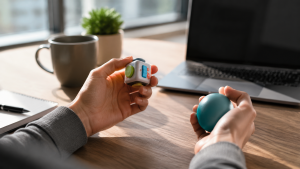
Visualization can be hard when your eyes are open and you're staring at a screen. That's where tactile anchors come in. Pick an object on your desk - a pen, a paperclip, a stress ball, even your mouse. For the next 60 seconds, give it your complete attention. Feel its texture, temperature, weight, and shape. Notice the tiny ridges, the smooth spots, the way it feels against your skin.
This technique is adapted from the "5-4-3-2-1" grounding exercise used in anxiety therapy, but it's compressed and focused on a single object. The tactile sensation pulls your brain out of rumination and into the present moment. It's especially effective in noisy environments because you're not relying on sound - you're relying on touch.
I learned this the hard way. During a particularly chaotic week at a startup, I kept a metal paperclip on my desk. Every time I felt overwhelmed, I'd pick it up and feel the cold metal, the sharp bend, the slight give when I pressed. In 30 seconds, my heart rate dropped. The trick is to choose one object and keep it in the same spot. Your brain will learn the association: "I touch this, I calm down."
But there's a trade-off: if you're in a high-speed meeting, touching an object might look like fidgeting. The solution is to use your mouse. Gently rest your fingers on it, feel the plastic, the buttons, the scroll wheel. No one will notice. For a more structured approach to using your environment, see our article on How to Set Up a Simple Home Meditation Space - the principles of intentional space apply to your desk too, even if you can't rearrange the whole office.
Noise-Cancelling Visualization: Turning Clatter Into a Tool
You can't control the noise in an open office. But you can change your relationship to it. Noise-cancelling visualization is a technique where you mentally transform sounds into neutral or pleasant objects. For example: the hum of the HVAC becomes ocean waves. The keyboard clatter becomes rain. A coworker's phone conversation becomes distant birdsong.
I laughed when I first heard this. Then I tried it during a particularly bad day. The construction noise next door was unbearable. I started imagining it as a giant's heartbeat. Within a minute, the irritation faded. It sounds silly, but it works because your brain's emotional response to a sound is partly determined by your interpretation. The amygdala reacts to the meaning, not just the decibel level.
To practice: sit comfortably, eyes open or closed. Identify the loudest sound in your environment. Label it neutrally ("sound"). Then invent a new, benign source for it. Hold that image for 10 seconds. Let the sound wash over you. If you're interrupted, that's fine - just start again with the new sound. This technique is particularly useful for the 1-minute meditation you can do while waiting for a file to load or a meeting to start.
One common mistake: trying to force the sound to become "relaxing." It doesn't have to be. It just has to be neutral. The goal is to remove the emotional charge, not to create a spa-like atmosphere. Over time, you'll find that previously annoying sounds become just... sounds.
Posture-Specific Guidance: Meditating in a Chair vs. Floor
Most people assume they need to sit cross-legged on the floor to meditate. That's a myth. In fact, for desk meditation, sitting in your chair is often better because it's more accessible and less likely to cause discomfort. But there's a right way and a wrong way.
Chair meditation: Sit forward on the edge of your seat, not slouched back. Your feet should be flat on the floor, hip-width apart. Your hands rest on your thighs or on the desk. Your spine is straight but not rigid - imagine a string pulling the crown of your head up. This position keeps you alert but relaxed. The biggest mistake: leaning back. That invites drowsiness. If you're prone to falling asleep, sit slightly forward and keep your eyes half-open, gazing softly at a spot on the wall.
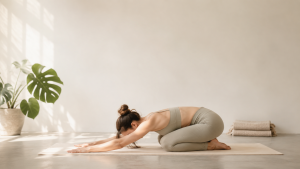
Floor meditation (if you have space): Use a cushion or folded blanket to elevate your hips above your knees. If your knees are higher than your hips, you'll strain your lower back. Sit with your legs crossed, or in a kneeling position if that's more comfortable. The floor allows for a more stable base, but it's harder to get up quickly if you're needed. I use chair meditation 90% of the time at work because it's seamless - I can go from meditation to typing in one second.
Ergonomic tip: if your chair lacks lumbar support, place a small pillow or rolled-up sweater at the small of your back. This prevents the slouch that compresses your diaphragm and makes deep breathing harder. For more on movement during breaks, see How to Do Chair Stretches for Office Desk Breaks - it pairs well with these micro-meditations.
How to De-Stress in 5 Minutes: A Structured Micro-Session
If you have a full 5 minutes between meetings, here's a sequence that combines the techniques above. I call it the "5-Minute Desk Reset."
- Minute 1: Close your eyes. Take 3 slow breaths - inhale 4, exhale 6. If noise bothers you, use the noise-cancelling visualization from above.
- Minute 2: Open your eyes. Pick up a tactile anchor (pen, paperclip, mouse). Spend 60 seconds exploring it with your senses.
- Minute 3: Set the object down. Practice mindful typing for 60 seconds. Type a neutral sentence slowly.
- Minute 4: Return to your breath. This time, add a simple mantra: on the inhale think "I am," on the exhale think "here." Repeat for 60 seconds.
- Minute 5: Slowly bring your awareness back to the room. Open your eyes fully. Stretch your neck and shoulders. Then continue your work.
This sequence works because it varies the focus - breath, touch, movement, mantra - preventing boredom and keeping you engaged. It's also interrupt-proof: if you're called away at minute 3, you've already gotten 3 minutes of benefit. Just pick up where you left off later.
The 2-Minute Quick Focus Reset Method
I get asked about this one constantly. The 2-minute quick focus reset is a specific technique popularized by productivity coach Brian Tracy, but adapted here for distraction-filled environments. The method: set a timer for 2 minutes. For the first 30 seconds, take 3 deep breaths. For the next 60 seconds, mentally review your top priority for the next hour. For the final 30 seconds, take one more deep breath and open your eyes.
What makes this different from a simple break is the intentional review of priorities. It's not just relaxation - it's recalibration. The deep breaths calm your nervous system, but the priority review reorients your attention. The result is a mental reset that reduces stress and improves focus.
I've used this before every high-stakes task: writing a difficult email, preparing for a presentation, making a tough decision. It's especially effective if you've been distracted by social media or email. The 2-minute reset breaks the loop and returns you to intentional work.
How to Do a 1-Minute Meditation (Even When You're Stressed)
One minute feels too short to matter. But it's enough to change your state. Here's the method I use when I'm so overwhelmed that even 2 minutes feels impossible.
Set a timer for 60 seconds. Place your hand on your chest, right over your heart. Feel the warmth of your palm. Breathe normally. With each exhale, silently say to yourself, "It's okay." That's it. The hand-on-heart gesture activates the release of oxytocin, a calming hormone, according to research on touch and stress. The phrase "It's okay" is a simple acceptance statement - it doesn't solve the problem, but it stops the spiral of panic.
I've done this in the bathroom stall, in the elevator, and even during a silent Zoom call with camera off. It's portable and invisible. The key is to not fight the stress. Acknowledge it. "It's okay to feel stressed. I'm handling it." After 60 seconds, the intensity usually drops enough that you can decide what to do next.
Most people don't realize that a 1-minute meditation is more effective than a 10-minute one when you're in acute distress. Why? Because you're more likely to actually do it. A 10-minute commitment feels impossible; 1 minute feels doable. And that single minute can create a breathing space that prevents a stress spiral.
Integrating Micro-Meditation Into Your Workflow
The biggest challenge isn't learning the techniques - it's remembering to use them. You need triggers. Here are three that work for me:
- Before every meeting: As you join the video call, take one breath before unmuting. That's a 5-second meditation.
- After every email send: The 30-second breath before hit send (from earlier) becomes a habit.
- When you switch tasks: Use the 1-minute hand-on-heart meditation. It marks the mental transition.
You can also set a recurring alarm on your phone for every hour. When it goes off, do one of the micro-meditations for 30 seconds to 2 minutes. The key is consistency over duration. Five 1-minute sessions per day are more effective than one 5-minute session, because they distribute the stress relief throughout the day.
If you're in a particularly noisy environment, combine the tactile anchor with the noise-cancelling visualization. Example: hold a paperclip and imagine the office noise as a waterfall. The two techniques reinforce each other. And if you get interrupted mid-technique, forgive yourself. Interruptions are part of the practice, not a failure. The goal is not to achieve perfect stillness - it's to build resilience in the conditions you actually have.
The Honest Truth: What Micro-Meditation Can and Can't Do
I want to be clear about the limitations. Micro-meditation is not a substitute for therapy, medication, or a proper break. If you're experiencing chronic stress, anxiety, or burnout, you need more than 30-second breaths. These techniques are for acute moments - the spike of irritation before a meeting, the tension that builds during a long task, the frustration of a noisy environment.
They also won't work if you're expecting immediate bliss. The first few times you try mindful typing, you'll probably feel annoyed. That's normal. The benefit is cumulative. After a week of consistent practice, you'll notice that your response to stress is slightly slower, slightly more measured. That's the win.
I've seen people try these techniques once, feel nothing, and give up. The thing nobody tells you about meditation is that it's a skill, not a magic pill. You wouldn't expect to lift a weight once and gain muscle. The same applies here. Stick with one technique for a week. If it doesn't work, try a different one. The right fit depends on your personality, your desk setup, and your typical distractions.
For a complementary approach to stress management, consider incorporating hydration breaks. Our article on Quick Tips for Staying Hydrated and Relaxed offers simple ways to pair water intake with calming rituals - a perfect partner to these micro-meditations.
When to Use Each Technique: A Decision Matrix
To help you choose, here's a quick guide based on your situation:
- High stress, under 30 seconds: The 30-second breath before hitting send
- Moderate stress, 1 minute available: Hand-on-heart 1-minute meditation
- Feeling scattered, 2 minutes available: 2-minute quick focus reset (breath + priority review)
- Need a body break, 2 minutes available: Mindful typing
- Noisy environment, any time: Noise-cancelling visualization
- Need grounding, 1 minute: Tactile anchor with a pen
- Full 5 minutes between meetings: The 5-Minute Desk Reset sequence
Print this list or keep it on a sticky note. Over time, you'll internalize the choices. The goal is to make the decision automatic: when stress hits, you reach for a technique instead of reaching for a distraction.
Final Thoughts: Realism Over Perfection
I've been practicing desk meditation for years, and I still have days where I forget to do it. That's fine. The most important thing is to start small. Pick one technique - I recommend the 30-second breath before hitting send because it's the easiest to integrate - and do it for three days. Notice how you feel. Then add a second technique. Over time, you'll build a personalized toolkit that works for your specific desk, your specific noise, and your specific stress patterns.
Micro-meditation isn't about escaping the office. It's about learning to be present in the office, even when it's chaotic. And that's a skill that serves you long after you leave the desk.