Why Gentle Foot and Ankle Stretch Therapy Matters
When I first started working with clients who had chronic foot pain, I made the mistake of pushing too hard. I thought a good stretch meant a deep, almost burning sensation. But I learned the hard way that for stiff, tender, or anxious movers, that approach backfires. It triggers the nervous system to tighten up, creating more pain, not less. That's why I developed this gentle foot and ankle stretch therapy - a slow, prop-supported routine designed to help you move comfortably without fear.
If you've ever wondered, "What are some good stretches for the ankle and foot?" the answer isn't a list of advanced poses. It's about starting where you are, with micro-movements and breath, and building trust with your body. This article teaches you exactly how to do that, with modifications for plantar fasciitis, arthritis, or post-injury recovery.
Before You Begin: The Rules of Gentle Stretching
Gentle stretching is not about forcing a stretch. It's about inviting movement. Here are the three principles I teach every client:
- Stretch within your comfort zone. If you feel sharp pain, stop. Mild tension is okay - a 2 or 3 out of 10 on a pain scale. Never push into a 5 or higher.
- Breathe with each hold. Inhale as you prepare, exhale as you ease into the stretch. This activates the parasympathetic nervous system, reducing tension.
- Use props generously. A rolled towel, a yoga block, a cushion. These aren't cheating - they're tools that allow you to stretch safely when mobility is limited.
"The thing nobody tells you about gentle stretching is that it's harder than aggressive stretching. It requires more patience, more awareness, and more self-compassion. But it's far more effective for long-term healing."
Setting Up Your Space for Success
Find a quiet spot where you can sit comfortably on the floor, a chair, or a bed. Have these items nearby:
- A rolled bath towel or yoga block
- A small cushion or folded blanket
- A water bottle
- Optional: a tennis ball or lacrosse ball for self-massage
Wear loose, comfortable clothing. If your feet are very cold, warm them first with gentle rubbing or a warm foot soak. Cold muscles don't stretch well - they resist.
The Core Routine: 8 Gentle Foot and Ankle Stretches
Perform each stretch slowly, holding for 3-5 breaths (about 20-30 seconds). Repeat each stretch 2-3 times on each foot. The entire routine takes 15-20 minutes.
1. Seated Toe Sways (Micro-Movement for Stiff Toes)
Sit on a chair with your feet flat on the floor. Place a rolled towel under your toes. Gently sway your toes side to side, like a metronome. Keep the movement small - only a few degrees. Most people don't realize that toe stiffness often starts from lack of small, varied movement, not from a single injury. This motion lubricates the joints and wakes up proprioception.
Modification: If you can't move your toes actively, use your hand to gently guide them. Go slow, with the breath: inhale as you sway right, exhale as you sway left.
2. Supported Ankle Circles (Partial Range of Motion)
Lie on your back with a rolled towel under your ankle. Lift one foot slightly off the floor. Draw tiny circles with your big toe - not full ankle circles, but partial ones, about the size of a quarter. Move clockwise for 5 breaths, then counterclockwise. This is a key difference from generic "ankle circles" that often cause pain in people with limited mobility.
"How to loosen tight feet and ankles?" Start with these micro-circles. They are safe even for post-injury rehabilitation.
3. Towel Calf Stretch (Gentle Heel Cord Stretch)
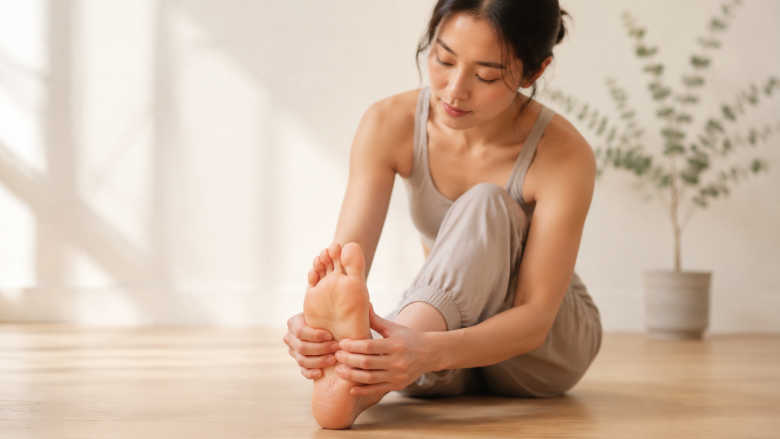
Sit on the floor with your legs straight out in front. Loop a rolled towel around the ball of one foot. Gently pull the towel toward you until you feel a mild stretch in your calf and heel cord. Keep your knee slightly bent - never lock it. This avoids straining the back of the knee. Hold, breathe, and release.
"How do I stretch my heel cords?" This is the safest way. Many people with tight calves try to do a standing calf stretch with a straight leg, but that can aggravate plantar fasciitis. The seated version with a towel gives you total control over intensity.
4. Big Toe Isolation (For Bunion and Hallux Rigidus Recovery)
Place a yoga block or thick book against the wall. Sit facing the wall, with the ball of your foot on the block and your heel on the floor. Gently press your big toe into the block, then lift it. This isolates the big toe joint without forcing a stretch. If you have arthritis, this is a "good stretch for your feet" that doesn't aggravate inflamed joints.
5. Seated Figure-Four Ankle Stretch (For Ankle Stiffness)
Sit on a chair. Cross one ankle over the opposite knee, like a figure-four. Let your foot hang loose. Gently circle your ankle in both directions. This opens the ankle joint in a non-weight-bearing position. It's excellent for people who feel ankle stiffness when walking.
6. Toe-Spread with a Yoga Block
Place a yoga block or a rolled towel between your toes - specifically between the big toe and second toe. Gently squeeze your toes together, then spread them wide. This stretches the interosseous muscles and can relieve cramping. Most people never think to stretch the spaces between toes, but that's where many trigger points hide.
7. Wall Calf Stretch with a Bent Knee
Stand facing a wall, hands on the wall at shoulder height. Step one foot back about 12 inches, keeping that knee slightly bent. Press the heel of the back foot into the floor. You should feel a stretch in the lower calf, not the upper calf. This specifically targets the soleus muscle, which is deeper and often tighter than the gastrocnemius. If you feel pain in the Achilles tendon, shorten the step back - you're going too far.
8. Restorative Ankle Rock
Kneel on a cushion or folded blanket with your toes tucked under. Gently rock back and forth, letting your weight shift from your toes to the balls of your feet. This is a dynamic stretch that mobilizes the ankle joint in a gentle, rhythmic way. If kneeling is painful, sit on a chair and place your foot on a tennis ball, rolling it under your arch as you rock.
How to Adapt These Stretches for Common Conditions
Plantar Fasciitis
If you have plantar fasciitis, avoid aggressive stretching of the arch. Instead, focus on the calf muscles and the plantar fascia at the heel. The towel calf stretch (stretch #3) is your best friend. Also, try the "toe-splay" exercise: while seated, spread your toes apart and hold for 5 seconds. This gently stretches the fascia without pulling on the painful insertion point at the heel.
Never stretch the arch first thing in the morning - the fascia is contracted and can tear. Do a gentle foot massage or a warm-up walk first, as we discussed in our guide to how to unwind with a gentle evening stroll routine.
Arthritis (Osteoarthritis or Rheumatoid)
Stretch only when you are not in a flare. If joints are hot, red, or swollen, rest. Use micro-movements - partial ranges, not full ranges. The seated ankle circles (stretch #2) and toe sways (stretch #1) are ideal. Avoid any stretch that loads the joint in a painful arc. Use a yoga block or towel to prop and support.
Post-Injury (Sprain, Fracture, or Surgery)
Always get clearance from your healthcare provider first. Start with non-weight-bearing stretches like the towel calf stretch and anterior ankle stretch (flexing the foot toward you). Avoid active ankle circles until you have full pain-free range of motion. Use a rolled towel under the ankle for support. The key is to move slowly and never force. If you feel a sharp or stabbing sensation, stop immediately.
Breathing Techniques to Enhance Your Stretching
Breathing is the hidden ingredient that turns a mechanical stretch into a therapeutic one. Here's a simple pattern:
- Inhale: Prepare the movement. Imagine your muscles softening.
- Exhale: Gently ease into the stretch. Let your exhalation be longer than your inhalation.
- Hold: Breathe normally, but keep your attention on the sensation. If you notice tension, breathe into that area.
If you find it hard to focus on breath and movement simultaneously, try this: before starting the stretch, take three deep breaths. Then, during the stretch, count your breaths: "Inhale 1... exhale 1... inhale 2... exhale 2..." up to 5. This counting keeps your mind from wandering.
When to Stretch and How Often
Consistency matters more than intensity. Aim for 5-10 minutes of gentle foot and ankle stretching every day, preferably in the morning after waking or in the evening before bed. If you're stiff from sitting all day, a midday session can be a great reset. For a deeper dive on integrating movement into your day, see our guide on how to add gentle stretches to your daily breaks.
Avoid stretching right after a long walk or run, when muscles are fatigued and inflamed. Wait at least 20-30 minutes. Also, don't stretch cold muscles - do a 2-minute warm-up like gentle ankle circles in the air or marching in place.
Common Mistakes and How to Avoid Them
- Bouncing. Never bounce while stretching. It triggers the stretch reflex and can cause micro-tears. Keep movements smooth and controlled.
- Holding your breath. Very common. If you notice you're holding your breath, take a deep exhale and consciously relax your shoulders.
- Stretching through sharp pain. If it's sharp, stop. Back off until you feel only mild tension. The goal is not to feel the stretch deeply, but to feel it safely.
- Overstretching the arch. Many people pull their toes back aggressively, thinking they need to stretch the arch. This can strain the plantar fascia. Instead, focus on the calf and heel cord, which is the true source of tension.
When to Seek Professional Help
Gentle stretching is a wonderful tool, but it's not a substitute for medical care. If you experience any of the following, consult a physical therapist or podiatrist:
- Pain that persists for more than 2 weeks despite consistent gentle stretching.
- Numbness, tingling, or burning in the foot or ankle.
- Swelling that doesn't subside with rest and elevation.
- Inability to bear weight on the foot.
- A popping or tearing sensation during a stretch.
These signs may indicate a more serious condition like a stress fracture, tendon tear, or nerve impingement. A professional can create a tailored plan that addresses your specific needs.
The Mind-Body Connection: Why Gentle Stretching Works
When you approach foot and ankle stretching with gentleness, you're not just stretching muscles - you're calming the nervous system. Chronic pain often creates a cycle of tension and fear. Your body learns to anticipate pain and tightens up in response. Gentle stretching, combined with slow breathing and props, breaks that cycle. It tells your brain, "This is safe. You can relax."
This is why I always say: gentle stretching is not a compromise. It's a sophisticated approach that respects your body's current limits while gently expanding them over time. It's the difference between forcing a door open and lubricating the hinges so it swings open on its own.
Putting It All Together: A Sample Daily Routine
Here's a simple 10-minute routine you can do every morning or evening:
- Seated Toe Sways (1 minute)
- Supported Ankle Circles (2 minutes - 1 minute each foot)
- Towel Calf Stretch (2 minutes - 1 minute each foot)
- Big Toe Isolation (1 minute each foot)
- Seated Figure-Four Ankle Stretch (1 minute each foot)
- Toe-Spread with Yoga Block (30 seconds)
- Wall Calf Stretch with Bent Knee (1 minute each foot)
- Restorative Ankle Rock (1 minute)
Finish with a few moments of stillness, noticing how your feet feel. If you can, take a short walk - even just around the room - to integrate the new range of motion.
Final Thoughts: Stretch with Kindness
Your feet carry you every day. They deserve patience, not punishment. If you're new to stretching, or if you've had disappointing experiences with aggressive routines, this gentle approach is your starting point. Remember: you are not trying to achieve a certain look or flexibility. You are building a relationship with your body based on trust and respect. Over time, you'll notice subtle changes - less stiffness when you get out of bed, more ease when you walk, a sense of lightness in your step.
That's the true goal of gentle foot and ankle stretch therapy: not just to stretch, but to move with comfort and joy.