Why I Started Prenatal Yoga and What Most Guides Get Wrong
When I found out I was pregnant, the first thing I did was search for "gentle prenatal yoga for beginners." I was six weeks along, exhausted, and nauseous. The videos I found showed glowing women in their third trimester doing perfect poses. Nobody told me that the first trimester is often the hardest part of pregnancy for movement. I made the mistake of trying to follow a 15-minute flow designed for a 20-week belly when I couldn't even stand for five minutes without feeling dizzy. Here's what I learned: prenatal yoga isn't about following a rigid sequence. It's about responding to what your body tells you that day, from week 6 to week 40. This guide is built around that reality. You'll learn when to start, how to modify for each trimester, and which poses actually help with specific symptoms like sciatica, round ligament pain, and fatigue. If you're wondering whether you can even do yoga in the first trimester, the answer is yes - but with a very different approach than what you might expect.
When to Start Prenatal Yoga (and When to Wait)
Most people ask me: "What week should you start prenatal yoga?" The honest answer is that you can start at any point after you get a positive pregnancy test, as long as you have no bleeding, severe pain, or a condition that requires bed rest. However, the first trimester is a time of immense change. Your body is building a placenta, hormone levels are soaring, and you may feel more tired than ever before. According to the American College of Obstetricians and Gynecologists, exercise during pregnancy is safe and recommended, but they emphasize listening to your body and avoiding breathlessness.
If you're in the first trimester (weeks 4-13), I recommend starting with very gentle movement - 5 to 10 minutes - and only after you've had a conversation with your healthcare provider. The thing nobody tells you is that the first trimester is often the hardest time to do yoga because of fatigue, nausea, and breast tenderness. Many women skip it altogether and start in the second trimester. That's completely fine. You don't lose any "progress." The goal is to support your body, not to maintain a practice.
If you have a history of miscarriage, bleeding, or a high-risk pregnancy, your doctor may advise you to wait until after the first trimester. Always get medical clearance before starting any exercise program. For low-risk pregnancies, you can start gentle yoga at any time. Just be prepared to modify everything.
Key takeaway: Start prenatal yoga when you feel ready, but prioritize the first trimester's need for rest. There is no "right week" - there is only what feels right for you and your body that day.
How to Build Your Gentle Prenatal Yoga Practice: First Trimester (Weeks 4-13)
The first trimester is a survival game. Your energy ebbs and flows, nausea can hit at any moment, and you might feel like you're carrying a heavy weight even though your belly hasn't popped. I remember trying to do a simple cat-cow at seven weeks and nearly falling over because my balance was so off. That's normal. The hormone relaxin starts softening your ligaments early, making you more unstable.
Poses That Work (and How to Modify)
In the first trimester, focus on supine poses (lying on your back) and gentle seated stretches. Avoid deep twists, strong backbends, and any pose that compresses the abdomen. Here's a short list of safe, effective poses:
- Cat-Cow (Marjaryasana-Bitilasana): Great for easing lower back tension. Keep the movement small and slow. If you feel dizzy, stop.
- Child's Pose (Balasana): Use a pillow or blanket under your forehead and knees. This is your go-to pose for nausea and fatigue.
- Gentle Side-Lying Stretch (for hips and lower back): Lie on your left side (to improve circulation) with a pillow between your knees. Gently rotate your upper body.
- Seated Neck Rolls and Shoulder Shrugs: Perfect for desk time. You can do these in a chair without any equipment.
I also recommend incorporating paced breathing - inhale for four counts, exhale for six. This calms the nervous system and helps with morning sickness. If you have severe nausea, skip yoga entirely and just focus on sitting quietly with your breath. That counts as practice.
What to Avoid
Do not do any deep forward folds that compress the belly (like seated forward fold with your head on your knees). Avoid lying flat on your stomach (obviously) and avoid any pose that requires you to hold your breath or strain. Also avoid hot yoga or any heated environment. The NHS cautions against overheating during pregnancy, so keep your practice cool and comfortable.
When to Skip
If you experience any bleeding, severe cramping, or dizziness that doesn't resolve with rest, stop immediately and contact your doctor. These are red flags. The first trimester is not the time to push through discomfort.
Adapting Your Practice as Your Body Changes: Second Trimester (Weeks 14-27)
By the second trimester, your energy often returns, nausea fades, and you start to feel more like yourself. But new challenges appear: your belly grows, your center of gravity shifts, and you may experience round ligament pain (a sharp, stabbing sensation on the sides of your lower abdomen) or sciatica (a shooting pain down one leg). This is when you need to adapt your practice to target specific symptoms.
Round Ligament Pain Relief
Round ligament pain often hits when you change positions quickly - rolling over in bed, standing up too fast, or twisting. To prevent it, move slowly and deliberately in your yoga practice. Avoid any sudden twists or side-bends. Instead, try gentle pelvic tilts on your hands and knees. This helps stabilize the pelvic area and reduces strain on the ligaments.
Sciatica and Lower Back Comfort
Sciatica during pregnancy is common because the growing uterus puts pressure on the sciatic nerve. The best pose I found was pigeon pose - but with a major modification. Instead of the full version, do a reclined pigeon (lying on your back with one ankle crossed over the opposite knee). This takes the pressure off your belly. Hold for 30 seconds per side, and breathe deeply. If you feel any sharp pain, back off immediately.
Another excellent option is cat-cow with a focus on the tailbone tuck. As you exhale, tuck your tailbone under and round your spine; this releases tension in the sacrum. Many beginners don't realize that the tailbone tuck is more important than the backbend in pregnancy.
Can I Do Downward Dog While Pregnant?
This is a question I get asked constantly. The short answer is yes, but with caution. Downward dog is generally safe in the first and second trimesters as long as you maintain space between your belly and thighs. As your belly grows, you may find that the pose feels too compressed. In the third trimester, many women prefer to do a modified downward dog with their hands on a chair or a wall, or they skip it entirely. The key is to keep your spine long and not let your belly drop. If you feel any pulling in your abdomen, come out of the pose. Listen to your body - it's smarter than any rule.
The Second Trimester Sequence Shift
As your belly grows, you'll need to widen your stance in standing poses (like warrior II) to accommodate your hips. Also, avoid lying flat on your back for more than a few minutes after 20 weeks, because the weight of the uterus can compress the vena cava and reduce blood flow. Instead, practice on your side or use a bolster to elevate your torso. This is a critical adjustment that many generic sequences miss.
The Third Trimester: Preparing for Labor (Weeks 28-40)
By the third trimester, your body is heavy, your pelvis is loosening, and you're likely dealing with pelvic pressure, swelling, and fatigue. The goal of prenatal yoga now shifts from general wellness to labor preparation. You want to open your hips, strengthen your pelvic floor, and practice breathing techniques that will help you during contractions.
Pelvic Floor Awareness
Many beginners think kegel exercises are the only way to strengthen the pelvic floor. But yoga offers a more integrated approach. Try deep squats (Malasana) - with support. Place a rolled blanket under your heels and hold onto a doorframe or a chair for balance. This pose opens the pelvis and lengthens the pelvic floor. Breathe deeply into the belly. If you feel any pressure or discomfort, come out. Squats are not for everyone in late pregnancy, especially if you have a low-lying placenta or shortness of breath.
Breathwork for Labor
One of the most valuable tools you can learn is pursed-lip breathing (also called 4-7-8 breathing). Inhale through your nose for four counts, hold for seven, and exhale through your mouth for eight. This calms the nervous system and gives you a focal point during contractions. I practiced this every day in the third trimester, and when I was in active labor, I used it to stay calm through the intense waves. It's not a magic cure, but it's a concrete tool you can rely on.
Also try alternate nostril breathing (Nadi Shodhana). This balances the left and right hemispheres of the brain and reduces anxiety. It's a simple technique: close your right nostril with your thumb, inhale through the left, then close the left nostril with your ring finger, exhale through the right. Repeat for 5 minutes. Do this seated or lying on your side.
Equipment-Free and Desk-Friendly Options
If you're stuck at a desk in your third trimester, you can still do yoga. Sit on the edge of your chair, feet flat on the floor, and do seated cat-cow by placing your hands on your knees and rounding/arching your spine. Seated figure-four stretch (ankle over knee) is great for hips. Neck rolls and shoulder rolls relieve tension from carrying extra weight. You don't need a mat or any props.
A Gentle Prenatal Yoga Sequence for Beginners (All Trimesters)
You asked: "What is a gentle prenatal yoga sequence?" Here's a simple 10-minute sequence that works for any trimester, with modifications for each stage. This is the sequence I wish I had from the beginning. It's designed to be done on a mat or carpet, with a cushion or blanket for comfort.
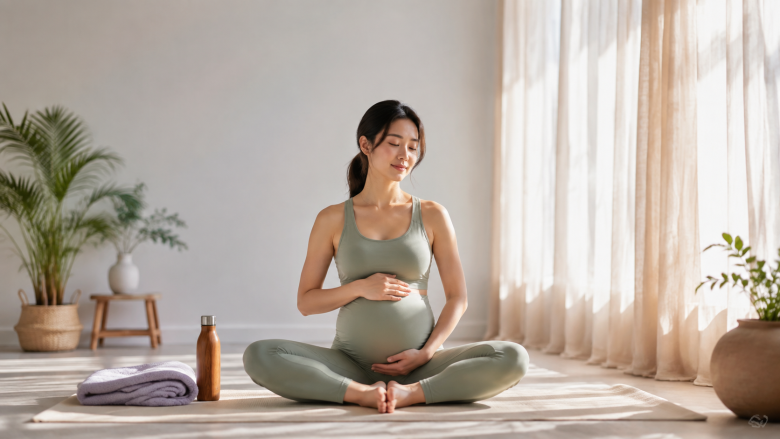
- Seated Centering (2 minutes): Sit cross-legged or on a chair. Place your hands on your belly. Inhale, imagine lifting your baby up. Exhale, release tension. Breathe slowly.
- Cat-Cow (2 minutes): On hands and knees. Inhale, arch your back and lift your head. Exhale, round your spine and tuck your tailbone. Move slowly, especially in the first trimester.
- Child's Pose (1 minute): Kneel, sit back on your heels, and fold forward. Place a pillow under your forehead. This is your rest pose.
- Standing Side Stretch (1 minute per side): Stand with feet hip-width apart. Raise one arm overhead and gently lean to the opposite side. Keep your belly relaxed. Do not compress.
- Warrior II (modified) (1 minute per side): Step feet wide, turn one foot out, bend the front knee to 90 degrees only if comfortable. Keep the back leg straight. Use a chair for balance if needed. Second trimester and beyond, widen your stance.
- Seated Forward Fold (with legs apart) (1 minute): Sit on the floor, legs wide apart (like a wide-angle seated pose). Place a pillow under your belly and fold forward only as far as comfortable. Do not compress.
- Side-Lying Relaxation (2 minutes): Lie on your left side, with a pillow between your knees and under your head. Close your eyes and breathe. This is your final relaxation.
This sequence is a starting point. You can adjust the time based on your energy. Some days you may only do the centering and child's pose. That's enough. The key is consistency, not intensity.
When to Skip Yoga: Red Flags and Contraindications
Knowing when to not practice is just as important as knowing what to do. Here are absolute contraindications for prenatal yoga, according to the ACOG Committee Opinion on Physical Activity During Pregnancy:
- Vaginal bleeding
- Placenta previa after 26 weeks
- Preterm labor or risk of preterm labor
- Cervical insufficiency or cerclage
- Severe anemia
- Heart disease that restricts activity
- Persistent dizziness or shortness of breath
Even if you don't have any of these conditions, there are "stop signs" you should always respect during your practice:
- Sharp pain anywhere, especially in the abdomen or pelvis
- Contractions that continue after resting
- Fluid leakage
- Headache that doesn't go away
- Sudden swelling in your hands, face, or feet
If any of these occur, stop your practice and contact your healthcare provider. Do not try to "work through" pain. That advice is for athletes, not pregnant people.
Beyond the Mat: Breathwork and Relaxation for Labor Prep
Prenatal yoga is not just about poses. The breathwork and relaxation techniques you learn can be your greatest allies during labor. I've already mentioned 4-7-8 breathing and alternate nostril breathing. Another powerful technique is Ujjayi breathing (ocean breath) - constrict the back of your throat slightly as you inhale and exhale through your nose, creating a soft ocean sound. This gives you a rhythm to focus on when contractions become intense.
For relaxation, try yoga nidra (guided relaxation). You can find free recordings online. It's essentially a body scan combined with intention-setting. For beginners, a 10-minute yoga nidra before bed can improve sleep quality, which is often disrupted in the third trimester. I used it every night, and it helped me fall asleep despite the constant need to pee.
If you're looking for a foundation to build your home practice, I recommend reading our Beginner's Guide to Gentle Home Yoga Poses for a deeper understanding of basic alignment and proper breathing. And for those days when you have only 10 minutes, check out How to Follow a 10-Minute Beginner Yoga Flow - it's a quick, safe routine that you can adapt with the modifications from this guide.
Final Thoughts: Your Body Knows Best
Gentle prenatal yoga for beginners is not about mastering poses or completing a 30-minute video every day. It's about building a relationship with your changing body. Some days you'll feel amazing and want to move. Other days, the best practice is lying on your side and breathing. Both are valid. The most important thing is to listen to your body's signals, respect the red flags, and give yourself grace. You are growing a human - that's the hardest work you'll ever do. Let yoga be a soft landing, not another task on your to-do list.