When I first started yoga for stress relief, I made a classic mistake: I treated it like a workout. I pushed into poses, held my breath, and wondered why I felt more wired than relaxed. It took a teacher gently placing a blanket under my knees and saying, 'This is not about achievement. This is about arrival.' to realize that gentle yoga is not just a softer version of yoga - it is a completely different conversation with your nervous system. If you are a beginner seeking relief from stress, the most important thing to know is that the poses themselves matter less than how you approach them. This guide pairs each pose with a breath cue and an interoception checkpoint - a moment to notice what you feel, not just what you do. You will learn why certain shapes calm the vagus nerve, how to use props like a supportive friend, and a 5-minute sequence you can do at your desk. No flexibility required. No experience needed. Just a willingness to slow down.
Why Gentle Yoga Works for Stress: The Nervous-System 101
Stress is not a thought problem - it is a physiological state. When your brain perceives a threat, your sympathetic nervous system (fight-or-flight) activates, releasing cortisol and adrenaline. The body does not know the difference between a work deadline and a saber-toothed tiger. Gentle yoga works because it triggers the parasympathetic nervous system - the rest-and-digest branch - primarily through the vagus nerve. This nerve runs from your brainstem to your abdomen, and it is the body's brake pedal. Slow, rhythmic movement and conscious breathing physically stimulate the vagus nerve, signaling safety to the brain. According to a 2015 study in the Journal of Alternative and Complementary Medicine, a single session of gentle yoga significantly reduced salivary cortisol levels compared to a control group. The key is not the pose itself but the quality of attention you bring to it. Most people don't realize that even a tiny frown or a clenched jaw can keep the stress response running. Gentle yoga invites you to undo those micro-tensions, one breath at a time.
The Role of the Vagus Nerve
The vagus nerve is like a two-way street: it sends signals from the brain to the body and from the body to the brain. When you lengthen your spine in a forward fold or soften your belly in a twist, you create space for the vagus nerve to function optimally. This is why gentle yoga for stress relief is not about stretching muscles - it is about communicating with your nervous system through movement. A simple practice: lie on your back with your knees bent, feet flat on the floor. Place one hand on your belly, one on your chest. As you inhale, feel your belly rise. As you exhale, let your belly soften. That is a vagal nerve massage. You can do this anywhere, anytime.
Setting Up for Success: Props, Space, and Mindset
Before you begin a single pose, let's talk about the environment. You do not need a fancy yoga studio or expensive gear. You need a quiet corner where you will not be interrupted for 10 minutes. A yoga mat is helpful but not essential - a carpet or rug works. For props, gather a firm blanket (or a beach towel), two blocks (or thick books, like hardcover novels), and a strap (a belt or scarf). One thing I learned the hard way: do not use a bed for gentle yoga. A mattress is too soft for proper alignment, and you will end up straining your lower back. Use a firm surface.
Props are not a crutch; they are a tool for safety. For example, in a seated forward fold, sitting on a folded blanket tilts your pelvis forward, allowing your spine to relax rather than rounding and stressing your back. In Child's Pose, a rolled blanket under your knees prevents hyperextension. The most common mistake beginners make is skipping props because they think it looks less 'yogic'. The truth is, props make the practice accessible and effective. They allow you to experience the pose without fighting your body. As we covered in the Beginner's Guide to Gentle Home Yoga Poses, setting up with intention is half the practice.
Mindset: The Interoception Checkpoint
Interoception is the sense of the internal state of your body - the ability to feel your heartbeat, your breathing, the tension in your shoulders. Most people ignore these signals until they become pain. In gentle yoga, we practice interoception deliberately. Before each pose, pause and ask: 'What am I feeling right now? Where is there holding or bracing?' Then, as you move, notice how that sensation changes. It is not about 'fixing' the feeling but about being present with it. This is where the stress relief happens. The thing nobody tells you about gentle yoga is that it is not always relaxing at first. You might feel restless, irritable, or even tearful. That is normal. Your nervous system is releasing stored tension. Let it happen. Self-compassion is the most important prop of all.
The 5-Minute Desk Break Sequence: A Rescue Practice for Tense Shoulders, Jaw, and Hips
Stress collects in three places most often: the shoulders (lifting toward the ears), the jaw (clenching), and the hips (tightening as if preparing to run). You can release all three in under five minutes, sitting at your desk. This is a sequence I use during workdays when I feel my shoulders creeping up. It is designed to be done in a chair, with no one noticing if you keep your eyes open.
Start by sitting tall, feet flat on the floor, hands on your thighs. Inhale, press your shoulders toward your ears as hard as you can. Exhale, drop them completely. Repeat three times. This 'shoulder shrug with breath' activates the relaxation response by contrasting tension with release. Next, bring your hands to your jaw. Open your mouth wide, then close it gently. Repeat three times, and notice if your jaw is more relaxed. Finally, place your right ankle on your left knee, sit up tall, and fold forward slightly. This is a seated hip stretch. Breathe into the outer hip for 30 seconds, then switch sides. For a deeper dive on integrating small movements into your day, see How to Add Gentle Stretches to Your Daily Breaks. This sequence works because it targets the vagus nerve indirectly - by releasing the physical armor of stress, you signal safety to the brain.
A Step-by-Step Beginner Sequence for Stress Relief (10 Minutes)
This is the core practice. Each pose is chosen for its ability to calm the nervous system, with specific alignment cues, prop use, and a breath cue. You will also find an interoception checkpoint - a moment to pause and notice. Do not rush. The sequence is designed to be done in order, but you can hold each pose as long as feels good.
Pose 1: Easy Seat with a Blanket (Sukhasana)
Sit on a folded blanket so your hips are higher than your knees. This prevents your lower back from rounding. Cross your legs gently - if your knees are much higher than your hips, place blocks or books under your knees for support. Place your hands on your thighs, palms up or down. Close your eyes or soften your gaze. Take 5 slow breaths, inhaling for 4 counts, exhaling for 6. Interoception checkpoint: notice the weight of your body dropping into the blanket. Is there any bracing in your belly or jaw? Allow it to soften. This pose activates the vagus nerve by grounding you in a stable, seated position.
Pose 2: Cat-Cow (Marjaryasana-Bitilasana)
Come to your hands and knees. Place your wrists directly under your shoulders and your knees under your hips. If your knees are sensitive, fold a blanket under them. Inhale, drop your belly, lift your chest and tailbone (cow). Exhale, round your spine, tuck your chin to your chest (cat). Move slowly, coordinating with your breath. Interoception checkpoint: during the exhale, imagine your spine lengthening like a cat stretching. Notice if you are holding your breath or tensing your neck. Most people hunch their shoulders toward their ears in cat pose - keep your shoulders relaxed. This pose massages the vagus nerve as it travels through the diaphragm. Repeat 5-8 rounds.
Pose 3: Child's Pose (Balasana)
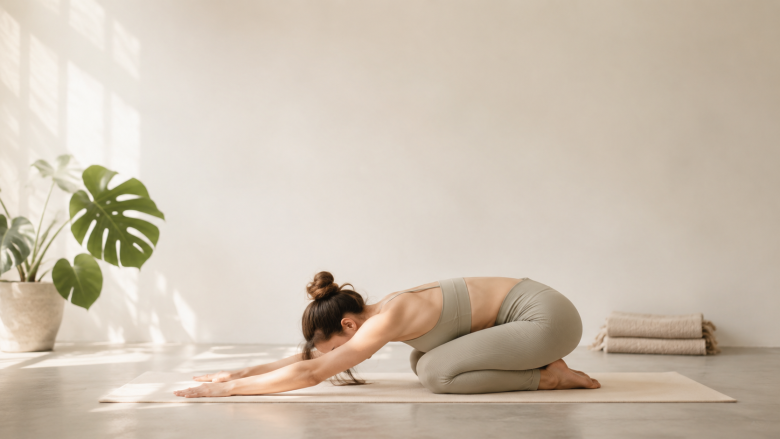
From hands and knees, bring your big toes together and sit back on your heels. Spread your knees wide if your belly needs space. Extend your arms forward, or rest them alongside your body. Place a folded blanket under your knees if they are uncomfortable. If your forehead does not reach the floor, rest it on a block or a fist. Breathe deeply into your back. Interoception checkpoint: feel the weight of your torso sinking toward the floor. Notice any resistance in your hips. Allow your exhale to be longer than your inhale. Child's Pose is a direct invitation to the parasympathetic nervous system - it compresses the front of the body, which can help lower heart rate. Stay here for 10-15 breaths.
Pose 4: Standing Forward Fold (Uttanasana) with Blocks
Stand with feet hip-width apart, knees slightly bent. Place two blocks on the floor at their highest height in front of your feet. Fold forward, keeping your knees bent, and place your hands on the blocks. Let your head hang heavy. You can also clasp opposite elbows and sway gently. Interoception checkpoint: feel the back of your neck lengthen. If you feel any sharp pulling in your hamstrings, bend your knees more. This is not a stretch - it is a release. The forward tilt of the head stimulates the vagus nerve and can lower blood pressure. Stay for 10 breaths, gently swaying if you like.
Pose 5: Legs-Up-the-Wall (Viparita Karani)
Sit sideways next to a wall. Lie on your back and swing your legs up the wall. Scoot your hips as close to the wall as comfortable. Place a folded blanket under your lower back if you feel any strain. Keep your legs straight but not locked. Arms rest by your sides, palms up. Close your eyes. Interoception checkpoint: notice the sensation of blood flowing back toward your core. Feel your heartbeat slow down. This is a restorative inversion that activates the vagus nerve and reduces cortisol. Stay for 3-5 minutes. If you feel any tingling or numbness in your feet, bend your knees and place your feet on the wall instead.
Pose 6: Lying Twist (Supta Matsyendrasana) with a Blanket
Lie on your back. Hug your knees to your chest. Then let your knees fall to the right, keeping your shoulders on the floor. Place a blanket or block under your right knee if it does not reach the floor. Turn your head gently to the left, or stay neutral. Hold for 10 breaths, then switch sides. Interoception checkpoint: feel the twist in your midsection, not forcing it. This pose wrings out tension from the spine and massages the abdominal organs, which is linked to vagal tone. Always support the knees to avoid straining the lower back.
Pose 7: Corpse Pose (Savasana) with a Bolster
Lie flat on your back. Place a folded blanket or pillow under your knees to support your lower back. If you feel vulnerable, place a blanket over your torso. Allow your feet to fall open. Arms rest at your sides, palms up. Close your eyes. For the next 3-5 minutes, just breathe naturally. Interoception checkpoint: scan your body from head to toe, noticing any remaining tension. Do not try to 'relax' - just observe. This is the most important pose of the sequence. Your nervous system integrates the practice here. If you find your mind racing, it is okay. Gentle yoga for stress relief is not about having a blank mind; it is about returning to the breath again and again.
Common Mistakes and How to Avoid Them
Even with the best intentions, beginners can undermine their practice. Here are three pitfalls I see often.
1. Holding your breath. When a pose is challenging, even mildly, many people hold their breath. This activates the sympathetic nervous system. The fix: if you cannot breathe smoothly, you are doing too much. Back off. Gentle yoga is not about pushing through. It is about finding the edge where you can still breathe.
2. Over-stretching to feel a 'release'. The idea that you need to feel a deep stretch to release tension is a myth. Over-stretching can irritate the nervous system and cause a protective bracing response. Instead, aim for a sensation of 'ease' - about 50% of your maximum stretch. Use props to support that ease.
3. Comparing yourself to others. If you are following a video or a class, it is easy to feel like you should be 'deeper' or 'more flexible'. This comparison is a mental stressor. Remember: the goal is not to look like the person on the screen. The goal is to feel different inside. Your body is unique, and your practice should honor that. For more on building a sustainable home practice, see How to Follow a 10-Minute Beginner Yoga Flow.
How to Build a Sustainable Practice: From 5 Minutes to 20 Minutes
You do not need to do an hour of yoga to see stress relief. In fact, starting with 5 minutes a day is more effective than doing 30 minutes once a week - consistency builds the neural pathways for relaxation. The 5-minute desk break sequence above is perfect for busy days. On days when you have more time, try the 10-minute sequence. Eventually, you can expand to 20 minutes by adding a few more rounds of Cat-Cow or holding Legs-Up-the-Wall longer. The key is to listen to your body. Some days, Gentle Yoga might mean lying in Corpse Pose for 10 minutes. That counts. The practice is not about the poses; it is about the intention to be kind to your nervous system.
If you want to weave gentle movement into your evenings, the How to Unwind with a Gentle Evening Stroll Routine offers a complementary approach - a slow walk with mindful breathing can also activate the vagus nerve. And for broader stress management strategies, 5 Practical Tips to Ease Everyday Stress provides a handy checklist.
Adjusting Poses for Specific Tension Areas: Hips, Jaw, and Shoulders
Stress does not distribute evenly. Many people carry tension in the hips from a 'ready to run' survival response. Others clench their jaw unconsciously. Still others have shoulders that never seem to drop. Here is how to adapt the sequence above for each area.
For hips: Add a gentle reclined pigeon pose. Lie on your back, cross your right ankle over your left knee, and thread your hands through the gap to pull your left leg toward your chest. Hold for 10 breaths per side. This releases the deep external rotators of the hip.
For jaw: In Corpse Pose or Easy Seat, bring your awareness to your jaw. Place your tongue on the roof of your mouth just behind your front teeth. Inhale, and as you exhale, let your jaw drop slightly. Do this 5 times. You can also do a gentle self-massage: with your fingertips, circle the muscles of your jaw in small circles for 30 seconds.
For shoulders: In Child's Pose, interlace your fingers behind your back and gently lift your arms away from your body. This opens the chest and counteracts the forward hunched posture of stress. Or, in Standing Forward Fold, clasp your hands behind your back and let your arms fall toward the floor. These poses release the pectorals and trapezius.
Final Thoughts: The Only Rule Is to Be Gentle with Yourself
Gentle yoga for stress relief is not a quick fix. It is a skill - a way of relating to your body that you can learn over time. Some days the practice will feel effortless, and you will float through the poses. Other days, you will feel restless, distracted, or even angry. That is okay. The practice is not about feeling good all the time. It is about showing up, with curiosity and compassion, for whatever arises. The most experienced practitioners still have days when they lie in Child's Pose for the entire sequence. And that is the point. The nervous system does not respond to force; it responds to safety. By offering yourself gentle movement, conscious breath, and a moment of interoception, you are telling your body, 'You are safe now.' That is the deepest stress relief there is.