Why Your Desk Needs a Micro-Break Game (Not Another To-Do List)
When I first started working from a cubicle, I made the mistake of thinking stress relief meant either a 10-minute walk outside or a full-blown meditation session. Neither worked during a 9:30 AM fire drill. What I actually needed was something I could do in my chair, in under five minutes, that wouldn't draw attention from the manager walking past. That's where desk-friendly micro-break games come in - not as a cure-all, but as a realistic, low-friction tool to reset your brain without leaving your seat.
Most articles on stress relief games for the office either list generic mobile apps (Tetris, Candy Crush) or team-building activities (Pictionary, Laughter Yoga). Neither addresses the reality of a shared workspace: noise constraints, limited space, and the need for a quick pause that doesn't derail your workflow. After spending two years testing options in open-plan offices, I've narrowed down the games that actually work - and more importantly, the ones that don't.
This guide is focused on quiet, solo, low-stimulation games you can play at your desk. Think of them as mental palate cleansers, not time sinks. The goal is to reduce stress, not add another distraction. Let's start with the most important question: how do you relieve stress in the office without leaving your chair?
How to Relieve Stress in the Office: The Seat-Based Approach
Stress at work usually comes from two sources: cognitive overload (too much information, too many decisions) or physical tension (hunched shoulders, stiff neck). The best micro-break games address both simultaneously. Here's a framework I use called the 3-2-1 Reset:
- 3 deep breaths (with a visual anchor, like a slow-moving screen saver or a physical object)
- 2 minutes of a low-cognitive-load game (pattern matching, not strategy)
- 1 minute of gentle movement (shoulder rolls, wrist stretches)
This sequence takes exactly five minutes and doesn't require closing your email or announcing a break. The key is the game itself - it must be something that occupies your focused attention just enough to stop the rumination, but not so much that you feel frustrated when returning to work.
For a deeper dive on the physical movement part, see our guide on chair stretches for office desk breaks. The stretches complement the mental reset perfectly.
What Makes a Game Office-Friendly? (The Unspoken Rules)
Before I list specific games, let's define the criteria based on real-world constraints. Most people don't realize that the biggest barrier to using stress relief games at work is social anxiety - not availability. You don't want to be that person tapping loudly on a phone or staring at a screen during a meeting. Here are the non-negotiable rules I follow:
- No sound required or produced. Even silent phone apps can be disruptive if you're in a quiet zone. Prefer physical objects or browser-based games that don't need audio.
- No screen glare for others. If your phone or monitor is visible to colleagues, avoid bright, flashing visuals. A dark-mode browser game or a matte desktop toy is safer.
- Instant pause/resume. You must be able to stop mid-action without losing progress. Realistically, in a 5-minute break, you might get interrupted twice.
- No physical movement beyond your desk. Standing up or stretching is fine, but avoid games that require walking around or hand gestures that could be misinterpreted.
- Low cognitive load. The game should be easy to learn and require minimal decision-making. The goal is to lower stress, not add mental friction.
Personal note: When I first tried playing a complex puzzle game on my phone during a break, I ended up more stressed because I couldn't solve it quickly. The thing nobody tells you about office stress relief games is that frustration is the enemy. Simple, predictable patterns work best.
Top 5 Desk-Friendly Micro-Break Games (Tested and Proven)
Here are the games I've personally used and recommended to colleagues. Each one meets the criteria above and can be played in under five minutes.
1. The Breathing Bubble (Browser-Based, Zero Setup)
This is the most effective stress relief game I've found for the office. It's a simple web app (many free ones exist, like ".breathing" or "Breathe2Relax") that shows a circle expanding and contracting. You match your inhale and exhale to the circle's rhythm. The 'game' element is trying to sync perfectly - it's almost like a rhythm game without sound.
Why it works: It forces you to slow your breathing without needing a timer. The visual anchor keeps your eyes off the screen's glare. Most people don't realize that a breathing exercise disguised as a game is easier to stick with than a meditation app.
Office etiquette: Use a dark background and keep the volume off. Some apps have a progress bar that shows streaks - that's the only element you want. Avoid ones with voice guidance unless you use headphones.
2. Tactile Desk Toys (Physical Objects, No Screen)
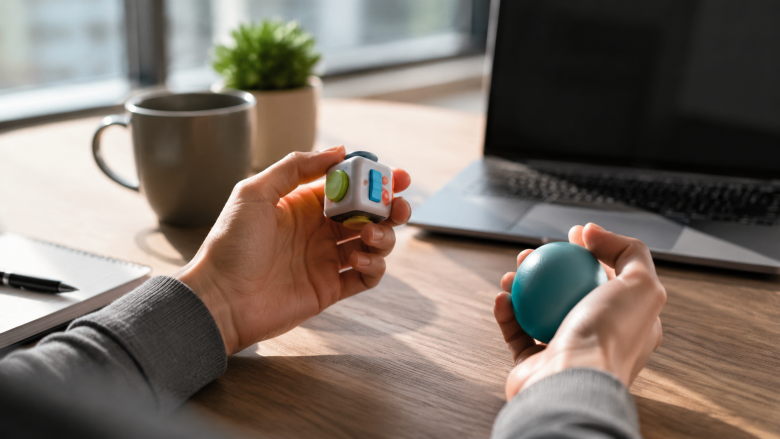
If you prefer a screen-free break, consider a small, silent fidget toy. The best ones for stress relief are those that require active manipulation rather than passive flipping. My go-to is a wooden cube puzzle that takes about 90 seconds to solve. You can also use a stress ball, but only if it's a quiet, non-squeaky one.
The trade-off: Fidget toys can be a double-edged sword. Some people find them distracting, and they can make noise if you're not careful. I've found that the best approach is to keep one specific toy in a drawer and only use it during designated breaks - not as a constant companion. For a broader look at managing everyday stress, see 5 Practical Tips to Ease Everyday Stress.
3. Pattern Tracing (Mental Game, No Tools)
This is a game I developed after realizing I had nothing on my desk. It's purely mental: pick a pattern on your desk (the grain of the wood, the weave of your mouse pad, the ceiling tiles) and trace it with your eyes for one minute. The challenge is to notice every detail - the tiny imperfections, the variations in color. You're essentially 'playing' a visual scanning game.
When to use it: When you're in a meeting that's dragging on and you need to stay engaged without looking at your phone. It's a stealth stress relief technique - nobody knows you're doing it.
4. The 2-Minute Word Game (Low Cognitive Load)
Open a text editor or a piece of paper. Pick a random word (e.g., "office") and try to create as many smaller words from its letters as possible. You have two minutes. This is a classic anagram game but without the pressure of a timer that's too short. The key is to stop exactly at two minutes, even if you have more words.
Why it's better than a crossword: Crosswords require external knowledge (trivia, culture). Anagrams only use the letters in front of you. This reduces cognitive load because you don't have to search your memory. It's pure pattern recognition.
5. Single-Player Card Games (Physical Deck, Quiet)
Keep a small deck of cards in your drawer. Games like Klondike Solitaire or Pyramid work well, but I prefer a simpler one: 'Speed Solitaire' without the timer. Just arrange the cards in order of suit and value. The tactile act of shuffling and placing cards is inherently calming. Avoid games that require a large spread of cards (like Spider) because they take up too much desk space.
Edge case: If you're in a noisy environment, the sound of cards shuffling might be too loud. In that case, use a digital version with the sound off. But the physical cards offer a sensory experience that digital can't replicate - the texture, the weight, the slight resistance of the cards.
What Activities Can I Do to Reduce Stress? (Beyond Games)
This is the second most common question people ask. While games are a great tool, they're not the only option. Here are seat-based activities that complement the games above, each with a specific stress trigger they address:
- For mental fatigue: The 5-4-3-2-1 grounding technique. Name 5 things you see, 4 you can touch, 3 you hear, 2 you smell, and 1 you can taste. This is a game in itself - a sensory scavenger hunt.
- For physical tension: Progressive muscle relaxation. Tense each muscle group for 5 seconds, then release. Do it while looking at a neutral object (like a wall). This takes 2-3 minutes and can be done without anyone noticing.
- For emotional overwhelm: Write down three things that are going well today. This is a 'gratitude game' - it shifts your focus from the stressful moment to a broader perspective. Keep it to one sentence each.
These activities are not games per se, but they share the same low-barrier, low-cognitive-load principle. The key is to treat them as micro-interventions - you don't need to schedule a 20-minute break. Just do one of them when you feel the stress building.
The Hidden Trap: Games That Seem Calming but Aren't
After testing dozens of options, I've identified a few that are commonly recommended but actually backfire in an office setting. Here's what to avoid:
- Color-by-number apps: They require a steady hand and good lighting. On a small phone screen, the strain on your eyes increases stress. Plus, they're hard to pause.
- Word search puzzles: They create a sense of urgency to find the words quickly. The frustration of not finding a word can spike cortisol.
- Any game with a competitive timer or score: Avoid games that show a high score or a countdown timer. These trigger the same stress response as work deadlines. The goal is to de-escalate, not to achieve.
- Multiplayer games (even async): Social pressure defeats the purpose. You don't want to feel obligated to respond to a friend's move during a break.
One more thing nobody tells you: the same game can be calming one day and stressful the next. If you find yourself getting impatient or irritated with a game, stop immediately. It's not working for you at that moment. Rotate between three or four options so you don't develop a negative association.
How to Build a Micro-Break Routine (Without Derailing Your Focus)
The biggest challenge is not the games themselves - it's the discipline to take a break without feeling guilty. Here's a step-by-step process that I use and teach:
- Set a trigger. Don't rely on willpower. Instead, tie your micro-break to a specific event: after finishing a task, before a meeting, or when you notice your shoulders are tense. I use a small sticky note on my monitor that says "5 minutes?"
- Choose one activity from your list. Keep a shortlist of 3 games/activities you like. Rotate them to avoid boredom.
- Set a timer for 5 minutes. Use a silent timer (a phone timer on vibrate or a browser plugin). Never use a sand timer - the sound of sand is distracting.
- Play the game with full attention. The point is to immerse yourself briefly, not to multitask. Don't check email while playing.
- Stop exactly when the timer goes off. This is non-negotiable. If you're in the middle of a move, finish it quickly and stop. The game is over. The break is over.
- Take one deep breath before returning to work. This signals to your brain that the reset is complete.
If you are working from home, the same principles apply, but you have more flexibility. See our guide on 10 Practical Tips to Ease Daily Stress at Home for ideas that work in a home office environment.
When to Use Each Game: A Decision Matrix
Not every game is right for every situation. Here's a simple table to help you choose based on your current state:
| If you feel... | Choose this game | Why it works |
|---|---|---|
| Overwhelmed, anxious | Breathing bubble | Slows down your nervous system through regulated breathing |
| Bored, restless | Anagram word game | Engages your brain without raising stress |
| Physically tense | Progressive muscle relaxation (not a game, but effective) | Releases muscle tension stored from sitting |
| Frustrated, angry | Pattern tracing | Shifts focus from emotion to sensory detail |
| Tired, low energy | Physical card solitaire | Gentle movement and tactile feedback re-energize without overstimulating |
This matrix is based on my own experience and feedback from colleagues. It's not a one-size-fits-all solution, but it gives you a starting point.
The Science of Low-Cognitive-Load Games (Briefly)
You don't need a PhD to understand why these games work, but a quick dive helps. When you're stressed, your prefrontal cortex - the part of the brain responsible for decision-making and impulse control - is overworked. A low-cognitive-load game, like pattern matching or simple anagrams, activates the default mode network (the brain's resting state) without pulling in the executive functions. This is the opposite of a complex strategy game, which keeps your prefrontal cortex engaged.
According to research from the American Psychological Association, brief mental breaks that involve shifting attention to a neutral, non-work-related stimulus can reduce cortisol levels within 5 minutes. The key is that the stimulus must be neutral - not exciting, not frustrating, not goal-oriented. That's why the games I've listed are deliberately simple.
One common misconception is that any distraction is helpful. Actually, watching a funny video or scrolling social media can increase stress because it introduces new information and social comparison. The games above are designed to be information-free - they don't tell you anything new about the world. They just provide a pattern to play with.
Final Thoughts: The Goal Is Not to Escape, But to Return
I've seen too many people use stress relief games as a way to procrastinate, which only adds more stress later. The purpose of a micro-break game is to give your brain a 5-minute vacation so you can come back to work with a clearer head. If you find yourself wanting to play longer, or if you feel guilty about stopping, you're using the game as an avoidance tool - not a stress relief tool.
Here's my honest advice: start with one game from the list above. Use it for a week. Notice how you feel after the break. If it helps, keep it. If not, try another. The best stress relief game for the office is the one you'll actually use, without making noise, without feeling guilty, and without telling your boss.